
With the rapid advancement of the electronics industry, production and assembly processes demand increasingly stringent cleanliness standards and precision handling. Gloves are an essential part of personal protective equipment (PPE) for operators who handle sensitive electronic components. The quality and performance of gloves directly influence product yield, component safety, and the overall cleanliness of the working environment. Among various glove options, clean nitrile gloves have emerged as the first choice in electronics manufacturing due to their superior performance, durability, and ergonomic design.
High Cleanliness Standards
In electronics manufacturing, even tiny amounts of dust, particles, or residues can compromise the performance and reliability of products. Most assembly and production processes are conducted in cleanrooms, which have strict particle control requirements. Depending on the product and process stage, cleanrooms are classified as Class 10, Class 100, or Class 1000, with increasingly stringent standards for airborne particles.
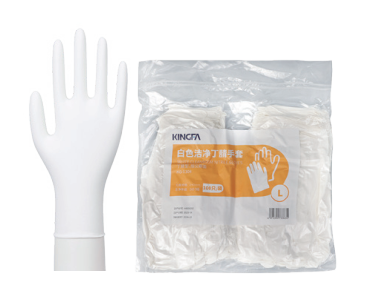
KINGFA clean nitrile gloves undergo thorough cleaning with ultra-pure water to minimize surface ion content, total non-volatile residues (NVR), silicon levels, and particulate contamination. These gloves are designed to meet the rigorous standards of modern cleanrooms, ensuring that operators can work in an environment that maintains the highest level of contamination control, thereby protecting product quality and reducing the risk of defects.
Anti-Static Performance
Static electricity is a major concern in electronics manufacturing, as even minor electrostatic discharge (ESD) can damage sensitive components, disrupt circuits, and reduce product lifespan. Nitrile gloves inherently provide excellent anti-static performance, helping to dissipate static charges and reduce the risk of ESD-related issues.
By incorporating anti-static properties, clean nitrile gloves prevent the accumulation of static electricity during handling, assembly, or inspection processes. This feature is crucial for electronics workshops that require continuous control of static electricity to maintain device reliability and production stability.
Sensitivity and Comfort
One of the key advantages of clean nitrile gloves is their combination of thinness, flexibility, and tactile sensitivity, which allows operators to handle delicate electronic components and precision instruments with confidence. The gloves conform to the hand shape, providing a comfortable and ergonomic fit that reduces stress on the hands during prolonged wear.
In addition, the stress-relief design of clean nitrile gloves ensures that force on the hands is minimized, reducing operator fatigue even during extended production shifts. This ergonomic feature not only enhances comfort but also improves operational accuracy and productivity in high-precision electronics tasks.
Durability and Chemical Resistance
Nitrile gloves are highly durable, offering exceptional resistance to tearing, punctures, and abrasions. This is particularly important for operators working with sharp tools, electronic components, and precision machinery over long periods.
Moreover, nitrile material exhibits strong chemical inertness, protecting hands from oils, solvents, and other chemicals commonly used in electronics manufacturing processes. This dual functionality—mechanical and chemical protection—makes clean nitrile gloves an ideal solution for operators who require both safety and reliability in their work environment.
Applications in the Electronics Industry
Clean nitrile gloves are widely used across various stages of electronics manufacturing, including:
1.Semiconductor fabrication: Handling wafers and sensitive chips in Class 10–100 cleanrooms.
2.PCB assembly: Soldering, inspection, and testing of printed circuit boards while minimizing contamination.
3.Component handling: Protection of microchips, connectors, and other delicate parts from oils, dust, and static damage.
4.Quality control and inspection: Ensuring precision measurements and defect-free products.
5.By maintaining high cleanliness, preventing ESD, and providing tactile sensitivity, clean nitrile gloves contribute directly to high-yield production, product reliability, and reduced defect rates.
Conclusion
As the electronics industry continues to evolve and production standards become increasingly demanding, clean nitrile gloves will play an ever more critical role in ensuring product quality, operator safety, and cleanroom compliance.
Their combination of cleanliness, anti-static properties, sensitivity, comfort, durability, and chemical resistance makes them indispensable for modern electronics manufacturing. Manufacturers and operators who invest in high-quality clean nitrile gloves can ensure consistent high-quality output, lower contamination risk, and improved operational efficiency.
In summary, clean nitrile gloves are more than just protective tools—they are essential enablers of precision, safety, and high-yield performance in the electronics industry.


